
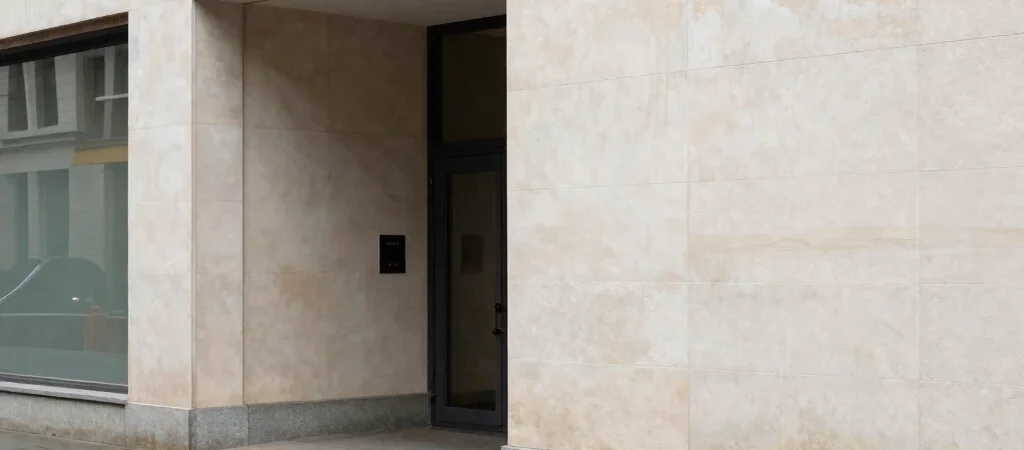
A facade is easy to read as a finished composition: openings, cladding, shadow, proportion. But architecture is not encountered as a flat elevation. It meets pavement, neighboring walls, changing light, and people arriving from somewhere else. Those encounters are part of the design, not background scenery.
Find the building’s edge
Look for the threshold between public and private space: a recessed entrance, a step, a canopy, or a small change in paving. That transition can tell us how the building addresses the street and whether arrival is legible from a distance. A tightly cropped image may leave the threshold out altogether, so a plan, section, or wider view can add essential context.
Read the neighboring scale
The buildings on either side help establish what a new facade is responding to. Compare its openings, height, and materials with what surrounds it, without assuming that resemblance is the goal. The useful question is what the project preserves, changes, or makes newly visible in that particular setting.
Give weather a place
Rain, wind, and strong sun are not special effects; they are conditions a building has to meet. Eaves, drainage, shading, and the way materials meet the ground can matter as much as the front view. When those decisions are missing from the image, look for project notes and technical drawings rather than asking the rendering to answer everything.